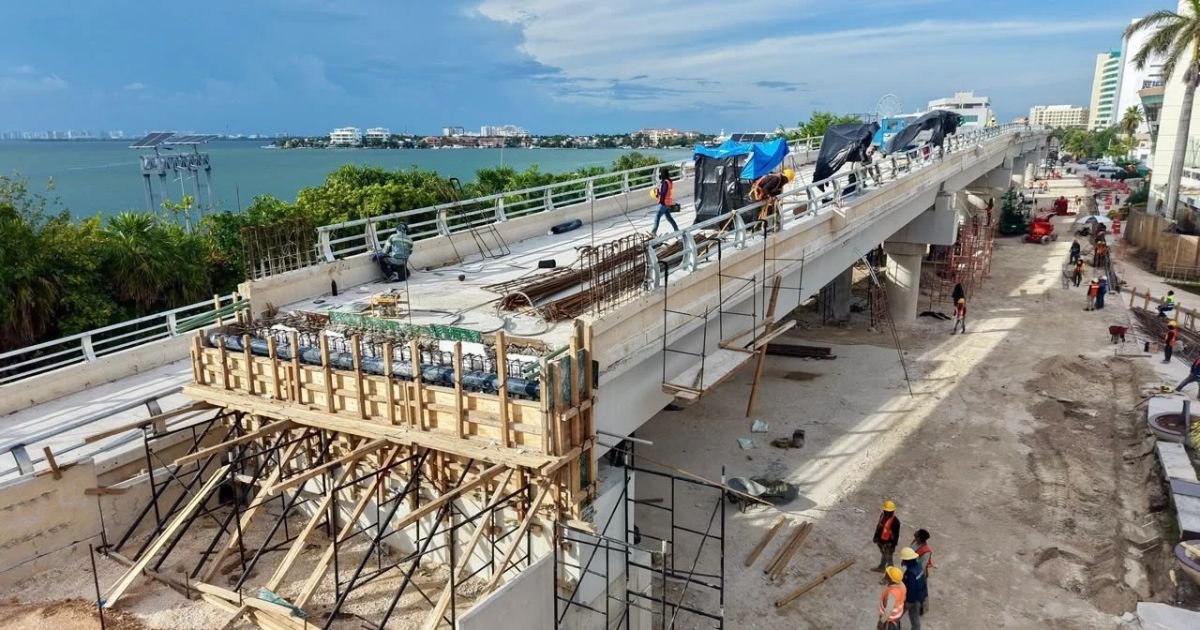
Cancún, Quintana Roo — The Kukulcán interchange, the project that will connect the Nichupté vehicle bridge with Kukulcán Boulevard, will be finished at the end of 2026, according to the latest reports from the Communications and Transport Department (SICT). The original target was October.
President Claudia Sheinbaum and Governor Mara Lezama inspected the work on Saturday, accompanied by SICT head Jesús Antonio Esteva Medina, as part of the president’s tour of Quintana Roo.
The federal project, backed by an investment of 484 million pesos, will link the bridge directly to the Hotel Zone and speed up travel between the city and Cancún International Airport.
The two-month slip from the original schedule follows a similar delay on the Nichupté bridge itself. In April, Ricardo Archundia, head of the Quintana Roo Tourism Infrastructure Institute (Infratur), said the Kukulcán overpass and its complementary works would be ready in October.
Sheinbaum inaugurated the Nichupté bridge on May 2, but its connection to Kukulcán Boulevard depends on completion of the interchange, which officials consider essential for the bridge to operate at full capacity.
As of Oct. 6, the SICT reported 74% progress on the interchange, with six active work fronts and 2,890 jobs generated.
“We carried out the supervision of the Kukulcán interchange in Cancún, Quintana Roo,” the president wrote on social media, where she marked Road Workers’ Day by recognizing the crews on these projects.
The project runs a total of 1.92 kilometers, including an elevated structure of about 770 meters and side roads that will connect it to existing streets.
It includes two independent sections: one with two lanes and another with a single lane running in the opposite direction, along with infrastructure designed to organize traffic flows.
Work fronts cover foundations, columns, piers, footings, beams, slabs and embankments, as well as underground drinking water and drainage systems.
The SICT estimates the project will benefit about 1.32 million residents and serve as an alternative route during peak tourist seasons and in the event of emergencies in the Hotel Zone.
More Development
- Quintana Roo Nautical Association Pursues Maritime Alliance With Belize
- Playa del Carmen’s Water Pollution Rules Exist but Go Unenforced, Activist Says
- Environmentalists Denounce Road and Gate Built in Cozumel Mangrove Tied to Royal Caribbean Project
- Cancún Hotel Zone Abandoned Lots Face 2027 Crackdown
- Quintana Roo Bat Expert Warns of Research Gaps and Cave Damage From Urban Growth
More Cancun
- Cancún to Open Art Sales Gallery With Works by 200 Local Creators in 2027
- Five Arrested on Drug Charges in Cancún’s Region 91
- Cancún DIF Detects 50 Child Labor Cases as Program Tracks 250 Families
- Day of the Dead Festivals Revive Cancún’s Economy as Tourists and Holiday Paychecks Flood In
- Cancún’s Day of the Dead Festival Draws More Than 110,000 Over Four Nights